Write the evidence before you write the lyric
To write a personalized song gift, start with three to five details that could not belong to another person. Add one emotional change and one sentence you want the recipient to remember. Only then choose the genre, rhyme, or song structure. A specific brief gives the lyric real material; a list of compliments usually produces a song that could be sent to anyone.
Useful evidence includes actions, places, repeated phrases, objects, and routines. 'She always supported me' is a conclusion. 'She stayed on the phone during every late drive home' is evidence. 'He taught me everything' is broad. 'He left the porch light on and waited beside the dented toolbox' gives the listener a scene. The evidence lets the song reach the conclusion without announcing it too early.
You do not need to be a songwriter to prepare this material. Write in plain sentences, keep the details accurate, and decide what the gift is meant to say. Rhyme can be repaired. A false or generic memory is much harder to fix because it weakens the entire point of the song.
Build a five-part story inventory
A blank page becomes easier when the story is divided into jobs. Fill one or two lines in each row. You will probably collect more material than the final lyric needs; that is useful because it gives you choices.
When a detail is sensitive, ask whether the recipient would be comfortable hearing it in the planned setting. A private nickname may be perfect for a one-to-one gift and wrong for a public wedding video. Personalization should increase recognition without removing consent or dignity.
| Story job | Question to answer | Useful detail |
|---|---|---|
| Opening scene | Where can the song begin? | A room, road, season, meal, message, or first meeting |
| Recognition | What will make them know it is theirs? | Nickname, phrase, object, habit, or exact place |
| Change | What became different because of them? | A decision, repaired relationship, confidence, home, or new direction |
| Emotional center | What is the song really saying? | Thank you, I choose you, I see you, I miss you, or I am proud of you |
| Future line | What should remain after the song ends? | A promise, invitation, wish, or next shared plan |
A five-step personalized song framework
The framework below works whether you write the lyric yourself or use an AI song tool. Treat it as an editing sequence. Finish each decision before moving to the next so that music choices do not hide a weak story.
Choose one emotional job
Decide what the song must accomplish in one sentence. Examples include 'thank Mom for the care I noticed too late,' 'show my partner that distance became part of our strength,' or 'make my best friend laugh before saying goodbye.' If the sentence contains several unrelated goals, narrow it. One clear job can support many memories; several competing jobs make the chorus vague.
Select three scenes
Pick an opening scene, a middle scene that shows change, and a present-day scene. They do not need to be the three biggest events. Choose moments you can describe with a place, action, object, or phrase. A packed lunch, blue scarf, missed train, repaired bicycle, or regular table gives the listener something to picture. Arrange the scenes in time unless another order creates a clearer emotional build.
Write the chorus promise in plain language
Before trying to rhyme, write what the chorus should mean. It might be 'you made ordinary life feel like home' or 'I will keep choosing the life we built.' Test the sentence against the scenes. If the verses do not provide evidence for it, either change the promise or choose better scenes. The chorus should feel like a conclusion the story earned, not a slogan attached at the end.
Choose sound after meaning
Genre and mood affect how the same words land. Piano leaves space for gratitude and grief; acoustic pop can feel warm and conversational; brighter indie pop can hold jokes and movement; a duet can represent a shared promise. Choose what the recipient would willingly listen to, not what seems most impressive. Vocal direction, tempo, and intensity should support the message rather than compete with it.
Edit for recognition and restraint
Read every line and ask two questions: would the recipient recognize this detail, and would they be comfortable hearing it? Remove repeated compliments, facts that need too much explanation, invented feelings, and private information that does not belong in the delivery setting. Keep one or two names or nicknames for moments where recognition matters. Repetition is valuable in a hook; it is distracting when every line repeats the same proof.
Replace generic lines with observable details
Generic language is not wrong, but it should arrive after the evidence. The edit is usually not about adding more adjectives. It is about replacing a conclusion with the action that created it.
Instead of 'You are always there for me'
Write the moment: 'You answered on the third ring while I drove past the old exit again.' The listener can infer reliability from the action, and the road gives the verse a setting.
Instead of 'Our love is so strong'
Name what it survived or repeated: two time zones, a year of job applications, the same difficult conversation, or every Sunday train. Strength becomes believable when the lyric shows its cost.
Instead of 'You are the best mom'
Use the care that earned the sentence: reheated dinners after practice, notes in a lunch bag, waiting-room coffee, or the phrase she used when you were afraid. Gratitude becomes personal when it notices labor.
Instead of 'We have so many memories'
Choose one sensory anchor: rain on the first date, flour across the kitchen, the cracked phone used for long calls, or the song playing in an almost-empty apartment. One scene can imply a much larger history.
How to use AI without surrendering the story
An AI song generator should shape material, not invent the relationship. Give it accurate scenes, the relationship, the occasion, the intended feeling, and boundaries around sensitive details. Ask for a lyric preview before generating the full audio so you can remove anything generic, exaggerated, or emotionally untrue.
In MeloLetter's brief, occasion and relationship set the point of view; the story supplies the timeline; private details create recognition; genre, mood, language, and vocal direction shape delivery. The useful work still belongs to the person giving the gift: deciding what is true, what matters, and what should remain private.
Do not paste a private diary, medical history, or full message archive when a short summary will do. Select only the details needed for the song. This keeps the brief focused and reduces the chance that sensitive information appears in a line you did not intend to share.
Provide
The occasion, relationship, three concrete scenes, one repeated phrase, desired emotional center, preferred sound, and the delivery context.
Review
Names, pronouns, timeline, implied promises, emotional intensity, rhyme choices, and whether every private detail is appropriate for the recipient.
Remove
Invented events, generic filler, claims the recipient would dispute, details that belong to someone else's story, and private facts that create discomfort instead of recognition.
Keep
The line that sounds like something you would actually say, the object or place only they will recognize, and the chorus promise supported by the verses.
The final gift-song checklist
Read the lyric once without the music. If the words could be sent to a different person after changing only the name, the brief needs more evidence. If the lyric is accurate but emotionally crowded, remove a scene rather than shortening every scene until none of them can breathe.
Then read it aloud at a normal speaking pace. Spoken words expose awkward formality, repeated ideas, and promises that sound larger than you intended. Mark any line you would hesitate to say directly to the recipient, and either rewrite it in your own language or remove it. After the lyric feels honest on the page, listen to the generated version without reading along. The important names, memories, and chorus promise should still be easy to understand. This two-pass review separates writing problems from arrangement problems and makes the final choice more deliberate.
Identity
The recipient, relationship, names, pronouns, and timeline are correct.
Recognition
At least three details are specific enough that the recipient will know where they came from.
Meaning
The chorus carries one clear thank-you, promise, celebration, apology, or expression of love.
Consent
Every private detail fits the planned audience and delivery setting.
Delivery
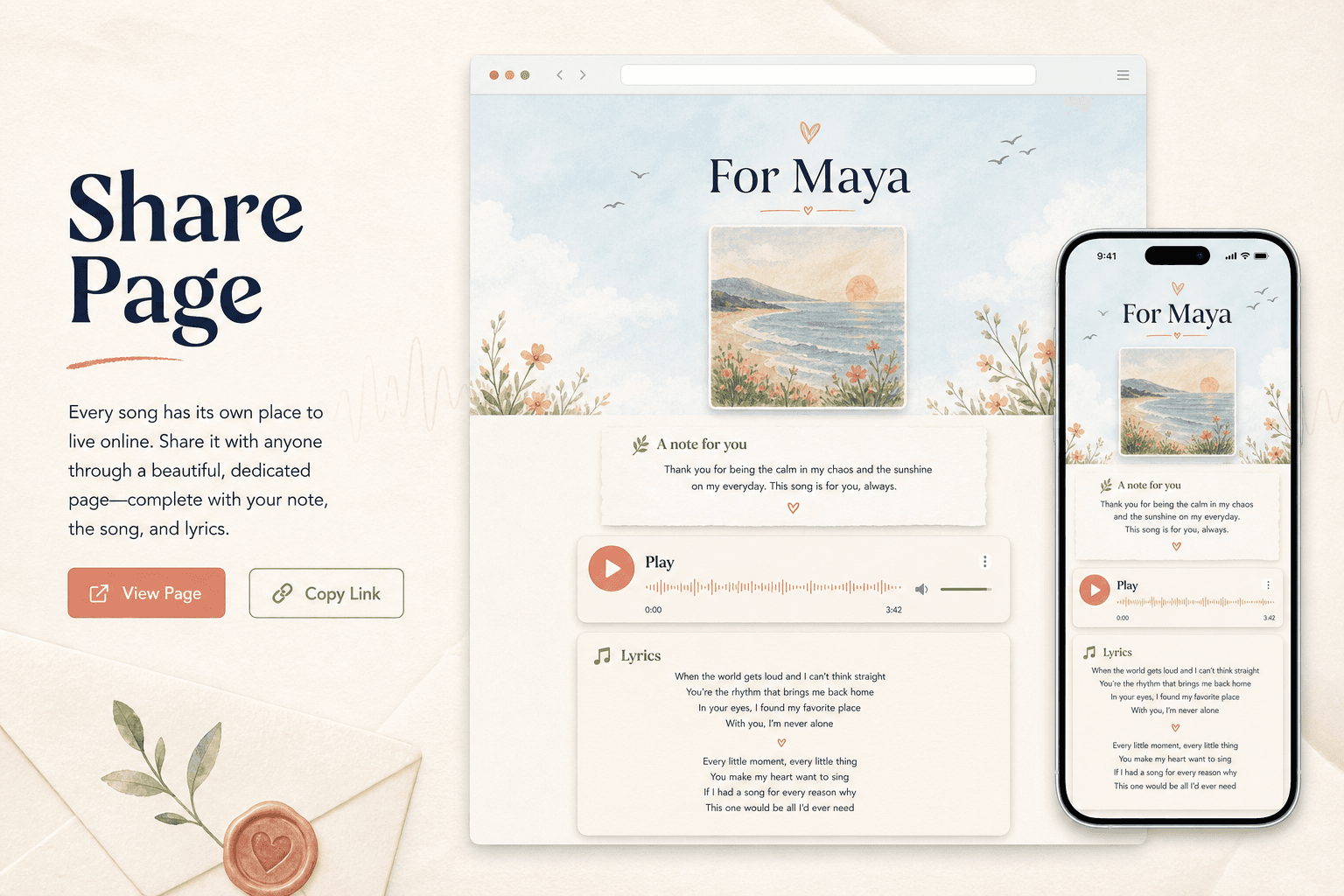
The link, audio, cover, note, lyrics, device volume, and offline backup have been checked before the moment.